
Business Requirement Configuration
Start With The Requirement.
Then Determine The Pathway.
Territory Gateway uses Business Requirement Configuration (BRC) to understand what an organisation is trying to achieve, assess what the requirement involves and configure an appropriate pathway forward.
Rather than beginning with a predefined service or solution, BRC begins with the requirement itself.
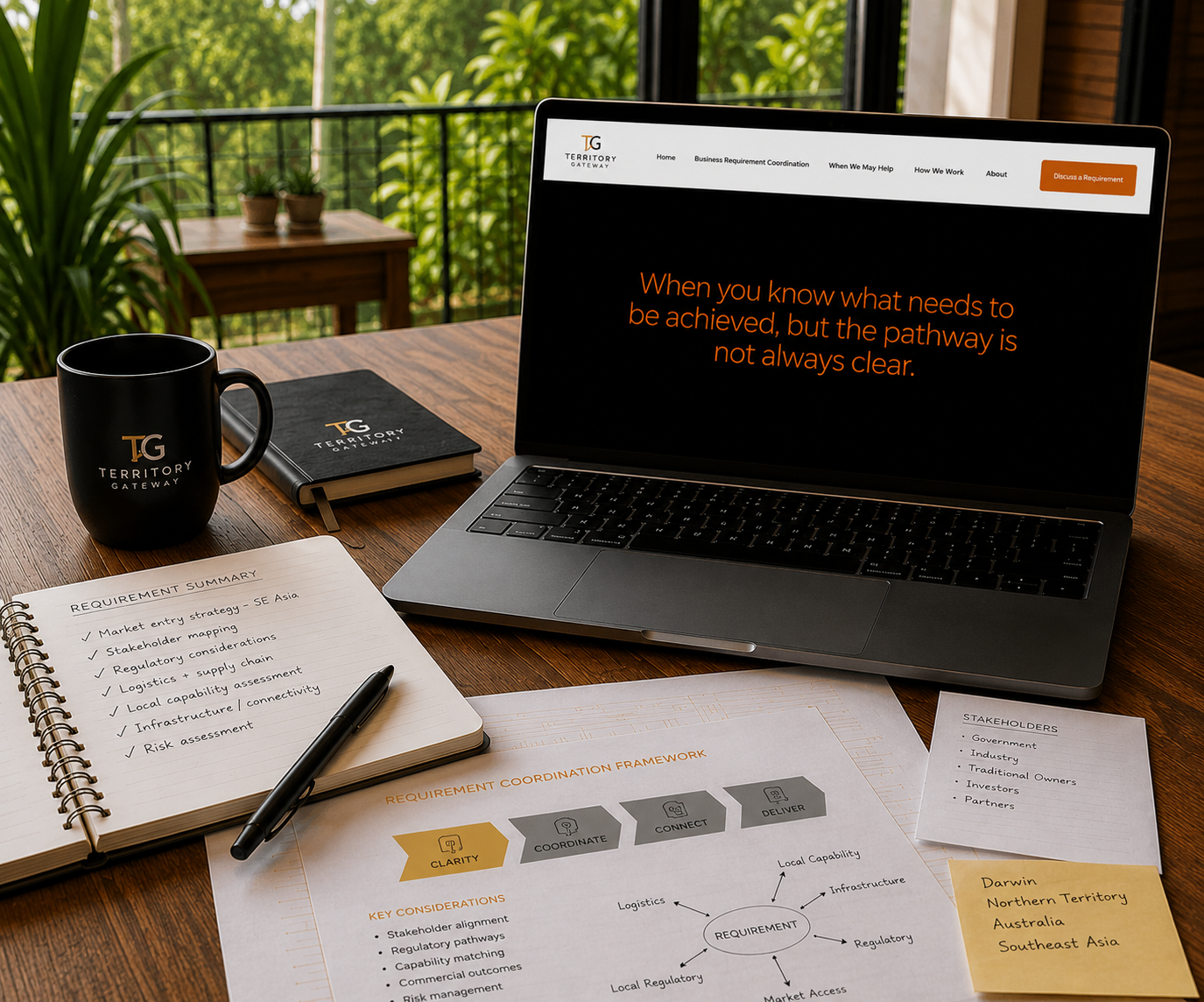
What is Business Requirement Configuration?
A Business Requirement Does Not Always Fit Neatly Within A Single Service, Provider or Internal Role.
Business Requirement Configuration (BRC) is Territory Gateway’s structured approach to understanding a business requirement, assessing what it involves and determining an appropriate pathway forward.
The process starts with the outcome an organisation is trying to achieve. From there, Territory Gateway works to clarify the requirement, identify the capabilities and responsibilities involved, and determine how those elements may need to be configured to move the requirement forward.
The resulting pathway will depend on the requirement. It may involve Territory Gateway directly, external providers or specialists, the client’s own capabilities, or a combination of these.
The starting question is simple:
“What Are You Trying To Achieve?”
Every requirement starts with an intended outcome.
Before considering providers, services or solutions, Territory Gateway works to understand what the organisation is trying to achieve, the context surrounding the requirement and any important constraints or conditions.
This creates the foundation for assessing the requirement and determining what capabilities, responsibilities and pathway may be appropriate.
Territory Gateway’s Role
Territory Gateway’s Role Is Shaped By The Requirement.
Depending on what is needed, TG may clarify the requirement, research relevant capabilities and options, configure an appropriate pathway, engage with relevant parties, support agreed work directly, coordinate where required, or connect the requirement with a better-positioned provider.
TG Does Not Need To Deliver Every Component Itself.
Where several capabilities or parties are involved, Territory Gateway can help determine how they may need to fit together, where responsibilities sit and what pathway may be appropriate. Coordination may form part of that pathway where it adds value.
How Business Requirement Configuration Works
Understand → Assess → Research → Design → Engage → Coordinate → Deliver
A structured process, adapted to the requirement.
Understand — Clarify the intended outcome, context, scope, constraints and what the requirement actually needs to achieve.
Assess — Consider feasibility, responsibilities, constraints and whether there is an appropriate pathway forward.
Research — Identify relevant capabilities, options and information needed to progress the requirement.
Design — Configure the capabilities, responsibilities and pathway appropriate to the requirement. Engage — Connect with relevant parties and establish the involvement needed to progress the pathway.
Coordinate — Support communication, responsibilities and interfaces across the pathway where coordination is required.
Deliver — Support the agreed pathway through to the appropriate outcome, with each party responsible for the capability they provide.
The depth of each stage depends on the nature of the requirement.
A Configured Pathway Forward
A Requirement Does Not Always Need A Single Provider or A Predetermined Solution.
Depending on what the requirement involves, the pathway may draw on the client’s own capabilities, Territory Gateway, external providers or specialists, or a combination of these.
Territory Gateway helps configure how the relevant capabilities and responsibilities fit around the requirement. Where several parties need to work together, TG may also support engagement and coordination across the pathway.
Have A Requirement To Discuss?
Tell us what you’re trying to achieve. We’ll consider the requirement and the appropriate next step.